
Fortress Product Expert
Answered by product specialists with product information and store enquires.

Answered by product specialists with product information and store enquires.

Enquire order status, delivery & installation, post-sales services or member account
Still have other inquiries?
See what others are asking

2026 Popular Coffee Machine Shopping Guide & Recommendation
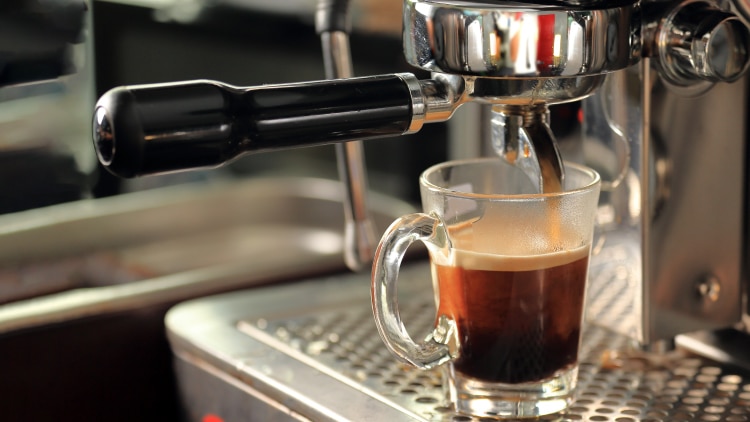
Many of us in the city love to drink coffee. Often this wonderful brew gives us the kick we need to start work every day. With a coffee machine you can brew your own coffee according to your own taste and preference. There are many types of coffee machines available now: drip type, capsule type and others with various features. Before shopping for a coffee machine, find out the functions of each product and things you need to look out for. The following is an overview with some recommendations.
In July 2026 the Consumer Council published its latest espresso machine test, carried out with the International Consumer Research & Testing organisation (ICRT). Ten samples were assessed, covering both fully automatic and semi-automatic models. The scores below cover the models stocked at Fortress.
← Swipe to see all scores →
| Product | Type | Brewing | Ease of Use & Personalisation | Quietness | Energy Efficiency | ICRT Overall |
| DELONGHI EXAM440.35.W Rivelia Fully Automatic Coffee Machine | Fully Automatic |
|
|
|
| 4 |
| DELONGHI ECAM380.95.TB Dinamica Plus Fully Automatic Coffee Machine | Fully Automatic |
|
|
|
| 4 |
| KRUPS EA9108 Sensation Full Auto Coffee Machine | Fully Automatic |
|
|
|
| 4 |
| PHILIPS PSA3228/01 Barista Brew Semi-automatic Espresso Machine | Semi-Auto (with grinder) |
|
|
|
| 3.5 |
| DELONGHI EC890.M Dedica Duo Pump-driven Espresso Coffee Machine | Semi-Auto (no grinder) |
|
|
|
| 3.5 |
| DELONGHI ECP35.31 Pump Espresso Coffee Machine | Semi-Auto (no grinder) |
|
|
|
| 3.5 |
| Gaggia RI9481 Classic E24 Semi Auto Espresso Machine | Semi-Auto (no grinder) |
|
|
|
| 3 |
Source: Consumer Council
← Swipe to see all scores →
| Product | Ease of Use | Quietness | Energy Saving | Personalisation | Overall |
| DELONGHI ECAM450.86.T Eletta Explore Fully Automatic Coffee Machine |
|
|
|
| 4 stars |
| PHILIPS EP2230/10 Fully Automatic Espresso Machine |
|
|
|
| 4 stars |
| DELONGHI ECAM290.61.B Magnifica Evo Fully Automatic Coffee Machine |
|
|
|
| 4 stars |
| PHILIPS EP1220/00 Fully Automatic Espresso Machine |
|
|
|
| 3.5 stars |
| Miele CM5510 Fully Automatic Silence Coffee Machine |
|
|
|
| 3.5 stars |
Source: Consumer Council
Recommended brands: DELONGHI , Nespresso , Gaggia , Ariete
Hot items: DELONGHI EC685 Pump Espresso Coffee Machine , Nespresso C40-SG-RE-NE4 Coffee Machine , DELONGHI DEDICA DUO EC890 Pump-driven Espresso Coffee Machine
The coffee machines required for making black coffee, mocha, espresso or Americano are different. Select a coffee machine according to personal taste and your consumption habit.
Detachable brewing components and a simple structure are key considerations when shopping for a coffee machine that is easy to clean. Easily assembled and disassembled models are great choices.
Coffee machines available on the market offer diverse functions such as "simmering", "pre-set", "auto extract", "auto milk frothing", "auto power-off". These extra functions add to the overall coffee experience.
If you have a busy schedule, get a capsule or fully automatic coffee machine. It provides good quality coffee easily and quickly. If you have more time to make coffee, select a semi-automatic coffee machine. It lets you mix different coffee beans to create a unique taste for more fun and creativity.
If you want to make coffee with milk foam such as lattes and cappuccinos or want to create latte art by drawing patterns on the surface of your coffee, get a coffee machine with a steam jet for making milk foam.
A: The main types are drip, capsule, semi-automatic, fully automatic and pour-over. Each brews differently, so the right one depends on how much control you want over the cup and how much time you want to spend making it.
A: Drip machines are the simplest to operate. Put a filter paper and ground coffee into the basket, pour in the right amount of water, then switch it on. The machine heats the water and drips it through the grounds to brew a full pot.
A: A fully automatic machine grinds, brews and rinses itself. Add coffee beans, set the strength and the number of cups, and it delivers freshly ground coffee at the touch of a button. Cleaning is largely handled by the machine as well.
A: Follow the cleaning and descaling schedule in your machine’s manual. As a general rule, wash the water tank, filter basket, coffee pot and grounds container regularly to clear coffee oils and grounds residue, and replace filters and water filters when they are due.
A: Prices range widely, from a few hundred dollars to well over ten thousand, depending on type, brand and features. Drip machines are the most affordable, while fully automatic machines sit at the top end. Choose according to your budget and how you drink coffee.
A: The biggest difference between the two is the insulation result. If you like to drink coffee immediately after it is brewed, select glass. If you like to spend a longer time to enjoy the taste, select stainless steel as it preserves heat better.
A: The freshness of coffee beans or coffee powder is particularly important for making coffee crema for the perfect espresso. Soluble oils are forced out of the coffee beans or powder with high pressure from the capsule, semi-automatic or full automatic coffee machine. This offers the coffee a fuller flavour and longer aftertaste.
A: Get an additional automatic milk frother to enhance the taste of your coffee. Just add fresh milk and switch on to enjoy smooth foamy milk. Enjoy fast production, fine milk foam texture and stable quality.
A: It can. The 2026 test found that some semi-automatic samples did not hold temperature steady when brewing continuously, with the first and third cups differing by as much as around 12.9℃. Fully automatic samples were generally more stable. Research cited in the report puts the ideal espresso temperature at roughly 67℃. If you often brew several cups back to back, temperature stability is worth checking.
A: Quite a lot. In the 2026 test, energy used for preheating and brewing ranged from about 3.6Wh to more than 48Wh, a gap of over ten times. Energy efficiency carries only 5% of the ICRT overall score, but on a machine you use daily the difference in running cost adds up.